Refrigerant is the part of aircon servicing that owners know least about. You cannot see it, you cannot measure it yourself, and you cannot tell by looking how many pounds went in. With no published reference price for R32 to compare against, that information gap gets even wider. The points below let you check things for yourself.
There are three things worth knowing before anyone puts refrigerant into your unit: which refrigerant your aircon uses, how the refrigerants differ in practice, and what to ask before agreeing on a price.
First, check which refrigerant your aircon uses
You can do this yourself in three minutes without calling anyone, and it is the most useful thing to know when you talk to a service provider. Once you can say straight away that the unit uses R32, any price conversation starts from facts you can check.
- 1
Go to the outdoor unit
The large unit outside the house or hanging on the wall has a data sticker on the side or back, usually silver or white.
- 2
Find the line marked Refrigerant
Some units print REFRIGERANT, others just R followed by a number. You will see R32, R410A or R22, together with the factory charge weight, for example 0.90 kg.
- 3
If the sticker has faded, look at the valve cover
Many brands print the refrigerant type near the service valves where the pipes connect. The manual and warranty card from when you bought it also say.
- 4
Use the age of the unit as a clue
Most inverter units bought in the last few years use R32, though some models are still R410A. A very old, non-inverter unit is quite likely to be R22.
- 5
Save it on your phone
Photograph the sticker with the refrigerant type, charge weight, model and serial number. Next time you need a technician, one photo gives them everything.
R32, R410A and R22 compared in practice
- Found in
- R32
- Most new inverter units
- R410A
- Mid-generation units from before R32
- R22
- Older units, mostly non-inverter
- Single or blended
- R32
- Single
- R410A
- Blend of two refrigerants
- R22
- Single
- Can it be topped up after a leak?
- R32
- Yes, once the leak is repaired
- R410A
- Yes, once the leak is repaired (charged as liquid), but I choose to recover it and weigh in a fresh charge
- R22
- Yes, once the leak is repaired
- Cooling efficiency
- R32
- Best of the three; less refrigerant for the same cooling
- R410A
- Good
- R22
- Lower than the other two
- Ozone layer
- R32
- Does not harm it
- R410A
- Does not harm it
- R22
- Harms it, so it is being phased out
- Global warming impact
- R32
- Clearly lower than R410A
- R410A
- High
- R22
- High
- Market status today
- R32
- The standard for new units
- R410A
- Still in existing units and some new models, but manufacturers are progressively switching to R32
- R22
- Harder to find and getting more expensive
- Chiang Mai market price per pound
- R32
- No reference price yet
- R410A
- About 75 THB
- R22
- About 25 THB
- Pro Fresh Care price per pound
- R32
- 25 THB
- R410A
- 25 THB
- R22
- 25 THB
| R32 | R410A | R22 | |
|---|---|---|---|
| Found in | Most new inverter units | Mid-generation units from before R32 | Older units, mostly non-inverter |
| Single or blended | Single | Blend of two refrigerants | Single |
| Can it be topped up after a leak? | Yes, once the leak is repaired | Yes, once the leak is repaired (charged as liquid), but I choose to recover it and weigh in a fresh charge | Yes, once the leak is repaired |
| Cooling efficiency | Best of the three; less refrigerant for the same cooling | Good | Lower than the other two |
| Ozone layer | Does not harm it | Does not harm it | Harms it, so it is being phased out |
| Global warming impact | Clearly lower than R410A | High | High |
| Market status today | The standard for new units | Still in existing units and some new models, but manufacturers are progressively switching to R32 | Harder to find and getting more expensive |
| Chiang Mai market price per pound | No reference price yet | About 75 THB | About 25 THB |
| Pro Fresh Care price per pound | 25 THB | 25 THB | 25 THB |
The clearest difference is the price per pound. The market price for R410A is around 75 THB per pound, and R32 has no reference price yet. I charge the same 25 THB per pound for all three, without a separate rate for each type.
Can R410A be topped up, and why I choose to recover it and weigh in a fresh charge
R410A is not a single substance but a 50/50 blend of R32 and R125. Even so, this blend behaves almost like a single refrigerant, so when the system leaks, the ratio of what is left drifts only very slightly. That is why technical references say it can be topped up once the leak is repaired, as long as it is charged as a liquid.
On my own jobs, I choose to recover all the old refrigerant, repair the leak, pull a vacuum to remove moisture and air, then weigh in a fresh charge to the amount on the unit's sticker. The reason is that once a unit has leaked, there is no way to know for sure how much refrigerant is left in the system, or whether moisture or air got in. Weighing in a complete fresh charge makes sure the amount and the blend are exactly to specification.
What I want to stress is that recovering and recharging does not raise your cost, because I charge 25 THB per pound for R410A, the same as R32. Doing it properly does not make the total more expensive in the way many people worry it will.
R22 is being phased out. What about the old unit at home?
R22 damages the ozone layer, so it is being phased out of production and use worldwide. For owners this means two things: it is getting harder to find, and the price tends to rise as it gets scarcer.
If your unit is still on R22 and working well, I do not recommend rushing to replace it. Consider it this way instead.
- Still cooling well, not leaking and cleaned regularly: keep using it.
- Leaking again and again so it needs topping up several times a year: time to compare whether a new unit makes more sense.
- The compressor fails in an old R22 unit: in almost every case, replacing the unit is better value than repairing it.
- Do not convert an R22 system to another refrigerant without changing the related components, because the compressor oil and operating pressure are different.
R32 is the new standard, but its price is still an information gap
Major manufacturers are progressively switching new inverter models in Thailand to R32 (CLASP data from 2019 found R32 in about 34% of models on sale, up from none in 2013). Manufacturers switched because it cools better for the same amount of refrigerant, so systems need less of it, and its global warming impact is clearly lower than R410A.
There is still no published reference price for R32. The prices I surveyed from Chiang Mai shops cover only R-22 and R-410A, so inverter owners have nothing to compare against before agreeing to a top-up.
My position is to charge 25 THB per pound for R32, the same rate the Chiang Mai market publishes for R22, and to tell you how many pounds before I add any.
Refrigerant does not get used up. If it is low, there is a leak
The most expensive misunderstanding is that refrigerant is a consumable that needs topping up every year, like changing the oil in a car. In fact an air conditioner is a sealed system. The refrigerant circulates in the same loop the whole time; it is not burned or used up.
So if it is low, it has leaked out somewhere. The places I find leaks most often are the flare joints at the pipe ends, copper pipe corroded by years of sun and rain, the service valves, and brazed joints on the coil. If you top up without finding the leak, the new refrigerant escapes the same way and the same problem comes back.
- What you noticeAirflow as strong as before but not cold
- Low refrigerant?
- Quite likely
- Could also be
- A failed capacitor stopping the compressor
- What you noticeAirflow clearly weaker
- Low refrigerant?
- Unlikely
- Could also be
- A blocked indoor coil or filter; needs a clean
- What you noticeIce on the larger copper pipe
- Low refrigerant?
- Possible
- Could also be
- A coil too dirty for enough airflow
- What you noticeCold at night but not during the day
- Low refrigerant?
- Possible
- Could also be
- A dirty outdoor coil that cannot shed heat
- What you noticeTopped up a few months ago and the problem is back
- Low refrigerant?
- Almost certainly a leak
- Could also be
- Nothing else; the leak has to be found
| What you notice | Low refrigerant? | Could also be |
|---|---|---|
| Airflow as strong as before but not cold | Quite likely | A failed capacitor stopping the compressor |
| Airflow clearly weaker | Unlikely | A blocked indoor coil or filter; needs a clean |
| Ice on the larger copper pipe | Possible | A coil too dirty for enough airflow |
| Cold at night but not during the day | Possible | A dirty outdoor coil that cannot shed heat |
| Topped up a few months ago and the problem is back | Almost certainly a leak | Nothing else; the leak has to be found |
Five things to check before agreeing to a top-up
- 1Which refrigerant does this unit use, and where did the technician check it? If they cannot answer, they have not looked at the data sticker.
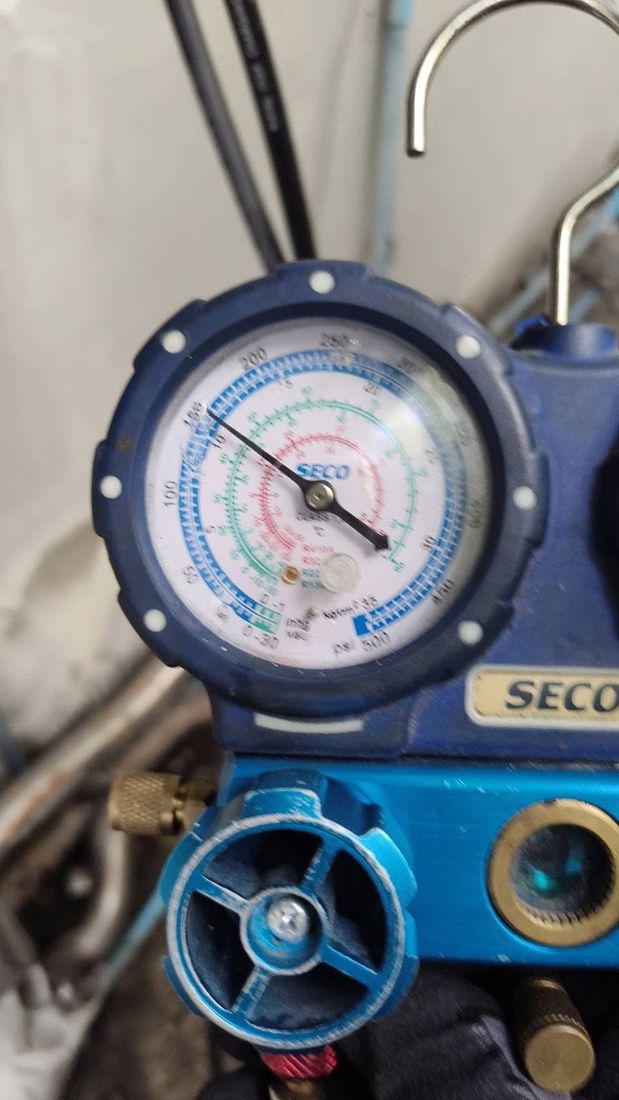
- 2What is the pressure reading now, how far is it from normal for this model, and can you see the gauges?
- 3Where has the missing refrigerant leaked from? Has anyone looked for the leak, and how will they check?
- 4How many pounds will go in, at what price per pound, and what is the total?
- 5If it is R410A, will the old refrigerant be recovered and a fresh charge weighed in to the amount on the sticker?
These five questions take less than two minutes, but they turn the conversation from trust alone into numbers you can check. A provider who follows the proper procedure can answer every one of them.
Not sure which refrigerant your aircon uses? Photograph the sticker on the outdoor unit and send it on LINE. I will check it at no charge and tell you honestly whether the symptoms need a top-up or just a clean.
Summary
- You can check the refrigerant type yourself on the sticker on the outdoor unit; keep a photo on your phone.
- R32 is the standard for new inverter units, more efficient and with less global warming impact than R410A.
- R410A is a blend that behaves almost like a single refrigerant. It can be topped up once the leak is repaired, but I choose to recover it and weigh in a fresh charge so the amount is exactly to specification.
- R22 is being phased out. A healthy unit can stay, but repeated leaks are a reason to consider replacing it.
- R32 has no reference price yet. I charge the same 25 THB per pound for all three.
- Refrigerant does not get used up. If it is low there is a leak, and the leak should be found before every top-up.