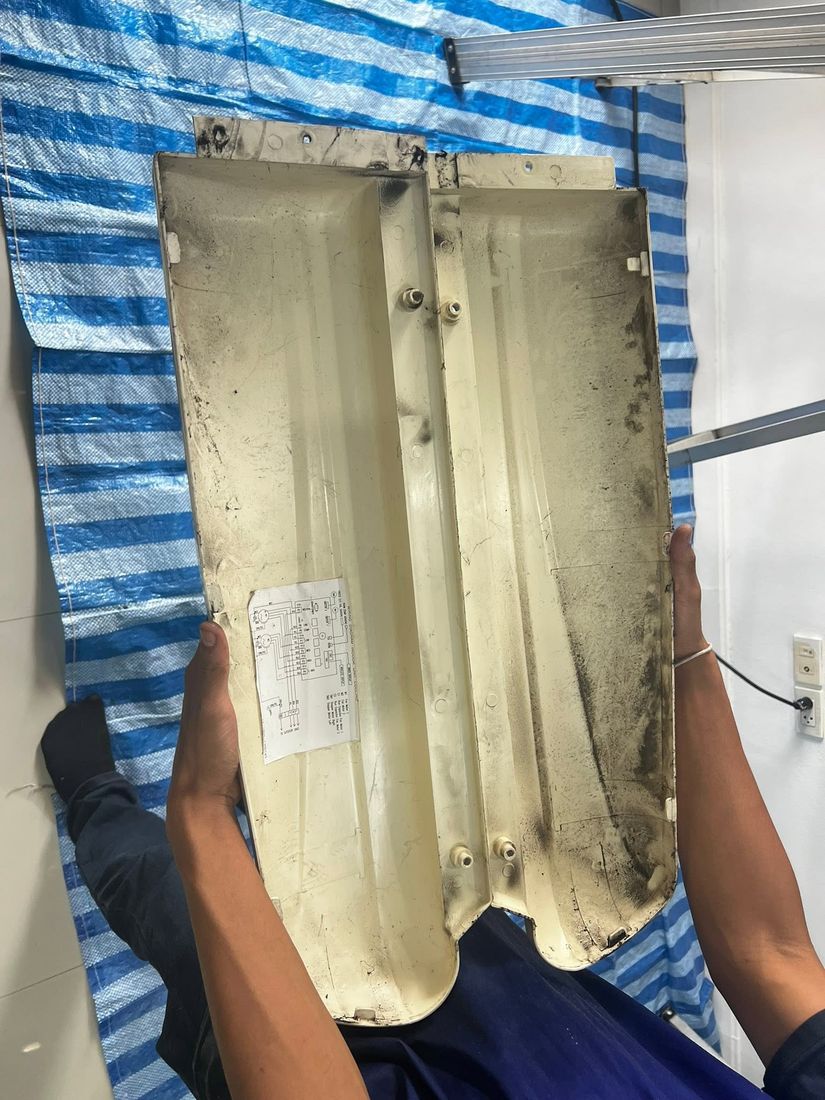
A musty smell in a room that stays closed all night directly affects how well you rest, and I understand you want it properly fixed. This problem follows a clear pattern: when you first switch the aircon on, the smell comes out with the first rush of air, then it fades until you get used to it. Some customers describe it as a musty smell like laundry that did not dry properly; others say it is sour, like something fermenting. All of these point to the same cause: something is living and growing inside the aircon.
What sets this apart from other aircon problems is that it does not stop the unit working. The aircon still cools and the airflow is still normal, so most people put off dealing with it, or spray an air freshener into the vents, which makes the problem worse in the long run. I explain why in the sections below.
Where the musty smell in an aircon comes from
The indoor coil of an aircon offers everything mould needs: moisture from water condensing all the time, a temperature that is not too hot, complete darkness, and food in the form of organic dust, skin flakes, pet hair and soot drawn in every day. The smell you notice is the volatile compounds these microbes give off as they grow.
The places where mould grows best are not the filters you can take out and wash yourself, but three spots deeper inside that you cannot see from outside.
- The blower wheel: the long cylindrical part behind the coil that spins to move the air. It has hundreds of small blade slots where damp dust sticks hard and a brush cannot reach.
- The drain tray under the coil: water runs through it all the time and some is always left standing, so it turns into slime and algae.
- The gaps between the indoor coil fins, where dust gets packed in until it forms damp mats stuck between the fins.
All three have one thing in common: the water sprayed through the front of the unit during a standard clean cannot reach them, or reaches only the surface. That is why in some homes the smell fades for only two to three weeks after the aircon is cleaned, then comes back.
Why the musty smell is especially bad in Chiang Mai's rainy season
Chiang Mai has clearly separate seasons, and its two main ones follow each other in a way that sets up a musty smell perfectly.
February to April is the smoke-haze season. Smoke from burning carries soot and fine ash that build up in the coil and blower wheel, which is like stocking up food for mould. Then from July to October, the middle to late part of the rainy season when rain is heaviest, the air is more humid, and the humid air passing over the coil condenses into more water than in other seasons. That completes the conditions mould needs.
The result is that an aircon that went through the smoke-haze season without a clean starts to smell noticeably in July to August in almost every home. If you notice your aircon has started to smell this year when it did not last year, it is usually not because the unit is faulty. It is because enough residue built up during the smoke-haze season to give mould a base to grow on in the rainy season.
How harmful is mould in an aircon?
In health terms, mould in an aircon is not something that makes a healthy person ill straight away, but it should not be ignored either, because of how it works: the people in the room breathe in spores blown out of the unit all night, in a closed room where the same air circulates for hours.
- People who already have respiratory allergies often notice a blocked nose, sneezing in the morning or a clearly irritated throat.
- People with asthma, for whom spores and damp are widely recognised triggers.
- Young children and older people who spend long periods in air-conditioned rooms are the groups to watch most closely.
- Most other people have no clear symptoms, but many notice they wake up with a dry throat or blocked nose only on nights the aircon is on.
There is another point that people often do not connect. During the smoke-haze season, the advice is to close the room and run the aircon to keep outside dust out, and the Department of Health's dust-free room guidance recommends choosing a room with an air conditioner because it can be sealed more tightly, and also lists cleaning the fan, the air conditioner and the air filters as one of the steps. But if that air conditioner has mould inside, what you get is a sealed room filled with spores instead of dust, which is no safer. Cleaning the aircon is therefore an essential condition for a dust-free room, not an optional extra.
Why deodorising sprays and coil cleaner sprays do not work
What most people try first is buying an aircon deodorising spray and spraying it into the vents. The fragrance does cover the musty smell for about two to three days, then the musty smell comes back, and in some cases stronger than before. There are two reasons.
- 1A deodorising spray works on the smell, not on the mould itself. As long as the biofilm on the blower wheel is still there, it keeps producing the smell.
- 2Many formulas use water as a solvent, so spraying them in adds moisture to a spot that is already damp, and the organic compounds in the fragrance become extra food. The result speeds up growth instead of stopping it.
As for the no-rinse coil cleaners sold in shops, they work to some extent on grime on the outer surface of the coil, but they cannot reach the blower wheel slots, which are the real source. Used the wrong way, they also leave residue on the fins that traps dust so it builds up faster than before.
Standard wash versus strip-down wash for a smell problem
For other problems, such as poor cooling from dust on the coil, a standard wash is usually enough. But for a musty smell in particular, the difference between these two methods decides whether it is fixed for good or only for a while.
- Source of the smellAir filters
- Standard wash 500 THB
- Fully clean
- Premium Full Wash 2,300–2,500 THB
- Fully clean
- Source of the smellFront surface of the indoor coil fins
- Standard wash 500 THB
- Clean
- Premium Full Wash 2,300–2,500 THB
- Clean
- Source of the smellDeep gaps between the coil fins
- Standard wash 500 THB
- Partly
- Premium Full Wash 2,300–2,500 THB
- Fully reached
- Source of the smellBlower wheel slots
- Standard wash 500 THB
- Cannot be reached; the most important spot
- Premium Full Wash 2,300–2,500 THB
- Removed and washed as a whole piece
- Source of the smellDrain tray, slime and algae
- Standard wash 500 THB
- Surface only
- Premium Full Wash 2,300–2,500 THB
- Removed and scrubbed completely
- Source of the smellInner frame and covers
- Standard wash 500 THB
- Not washed
- Premium Full Wash 2,300–2,500 THB
- Removed and washed as a full set
- Source of the smellEffect on the musty smell
- Standard wash 500 THB
- Fades for a while, usually comes back
- Premium Full Wash 2,300–2,500 THB
- Removed at the source
- Source of the smellDrip warranty
- Standard wash 500 THB
- 30 days
- Premium Full Wash 2,300–2,500 THB
- 60 days
| Source of the smell | Standard wash 500 THB | Premium Full Wash 2,300–2,500 THB |
|---|---|---|
| Air filters | Fully clean | Fully clean |
| Front surface of the indoor coil fins | Clean | Clean |
| Deep gaps between the coil fins | Partly | Fully reached |
| Blower wheel slots | Cannot be reached; the most important spot | Removed and washed as a whole piece |
| Drain tray, slime and algae | Surface only | Removed and scrubbed completely |
| Inner frame and covers | Not washed | Removed and washed as a full set |
| Effect on the musty smell | Fades for a while, usually comes back | Removed at the source |
| Drip warranty | 30 days | 60 days |
To put it plainly: if your aircon does not smell yet, a standard wash on schedule is enough, and there is no need to choose the more expensive service. But once a musty or sour smell appears, that is evidence the mould has reached places that spraying through the front of the unit cannot reach, and a standard wash will only work for a while. I assess this and tell you before the work starts, so you can decide with the full picture.
How I do a strip-down aircon wash
My strip-down wash covers the steps below, so you can check that the work you get matches what we agreed.
- 1
Lay down covers and cut the power before starting
A strip-down wash uses more water than a standard wash, so preparing the area and cutting the power supply is the first step I take on every job, and I take responsibility for keeping the work area tidy until the job is finished.
- 2
Remove the covers, filters and louvres
I take every plastic part off and wash it separately, because the grooves around the cover edges are another place where damp dust builds up.
- 3
Remove the blower wheel from the motor shaft
This is the step that sets a strip-down wash apart from a standard wash. I take the wheel out, soak it, then scrub it slot by slot until all the built-up grime is gone.
- 4
Remove the drain tray and scrub it
I scrub out all the slime and algae stuck in the tray, and clear the residue at the mouth of the drain line, which is often blocked.
- 5
Pressure-wash the indoor coil until the water runs clear
I wash from the back of the fins to push the dust out the way it came in, rather than forcing it deeper. The wash is only done when the water running off is clear.
- 6
Blow out the drain line and test the drainage
I pour in water to test that it drains freely out of the end of the line, because a line that is still blocked will bring the smell back within a few months.
- 7
Reassemble, blow dry, then test the unit
I run the unit to check the outlet air temperature, listen to the blower wheel to make sure it is balanced, and check there is no leaking at any of the joints.
How to keep the musty smell from coming back
After a strip-down wash, mould can always come back if the conditions inside the unit stay the same. What the homeowner does makes a real difference to how long it takes for the smell to return.
- Every time before you switch the aircon off, change to fan mode for at least 10–15 minutes, or longer if you can (Daikin's automatic mould-prevention function blows moisture out for about 1 hour), to dry the moisture out of the coil. This really works and costs nothing.
- Many models have a Clean or Self Clean button that does this automatically. Check your manual to see whether your model has it.
- Wash the filters yourself every 2 weeks as manufacturers recommend, and no longer than 4 weeks during the smoke-haze season, and always let them dry completely before putting them back, because a damp filter is a direct breeding ground.
- Do not keep the temperature lower than you need all the time, because the lower the temperature, the more water condenses.
- If the room is left closed for several weeks, such as over a semester break or while you are away, run the aircon in fan mode once before going back to normal use.
- Have a thorough clean in May to June, to clear out the soot from the smoke-haze season before the rainy-season humidity arrives.
Key points
- A musty or sour smell is a sign of mould and microbial slime, not just built-up dust.
- The main sources are the blower wheel and the drain tray, which spraying through the front of the unit cannot reach.
- The smoke-haze season builds up residue and the rainy season adds moisture, so the smell usually becomes noticeable in July to August.
- Deodorising sprays cover the smell for only a few days and can make the problem worse.
- Once there is a smell, go for a strip-down wash. If there is no smell yet, a standard wash on schedule is enough.
- Running fan mode to dry the unit before every switch-off is a prevention method that works and costs nothing.
If your aircon has started to smell musty, tell me whether the smell comes only when you first switch it on or all the time, and send a photo of the vents on LINE at @iu3333. This helps me tell whether a standard wash or a strip-down wash is the right choice.