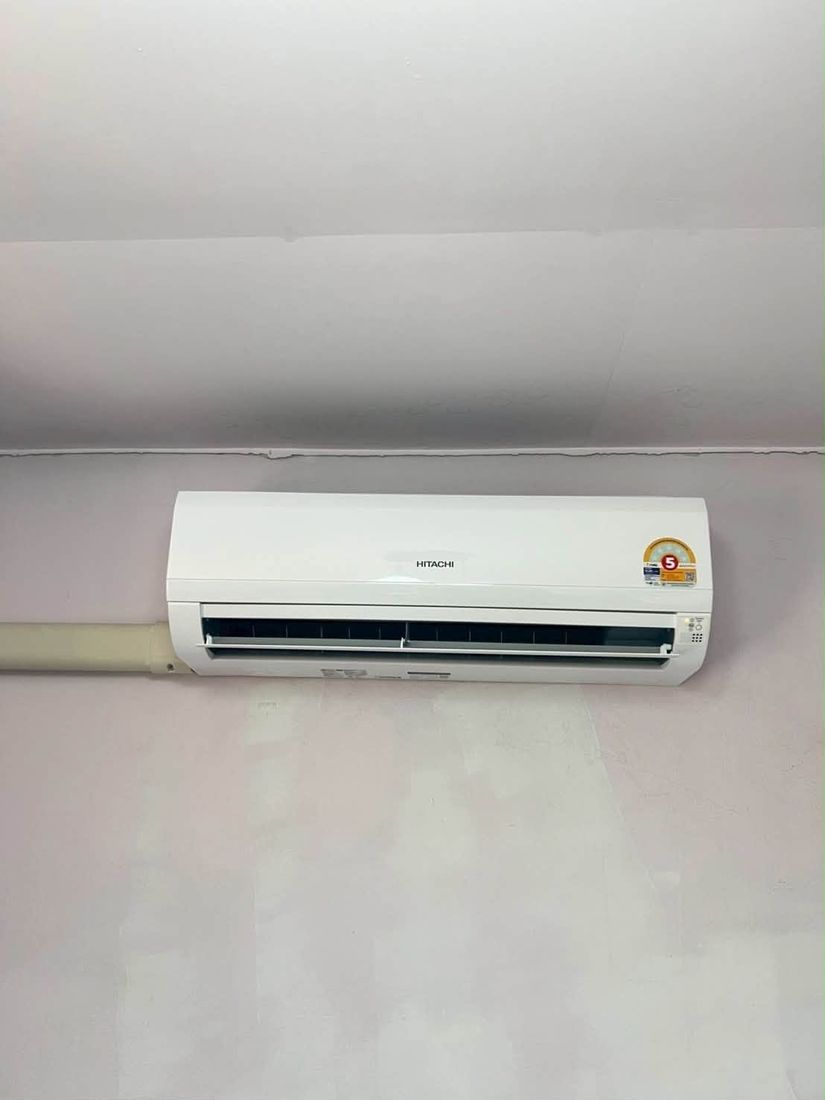
Choosing between an inverter and a non-inverter aircon is a hard decision, because the information you get in the shop usually stops at "it uses less electricity". That is true, but it is not the whole picture. The question to ask is not whether an inverter uses less electricity, but whether it saves enough in your home to justify the higher price of the unit and the risk of higher repair costs.
I will first explain how the two types work differently. Then I will cover the point that rarely comes up when you are choosing: the repair cost when an electronic part fails. Finally, I will go through how to choose based on how you actually use the room. By the end, you will have the criteria to decide for yourself.
How a non-inverter aircon works
A non-inverter aircon, also called fixed speed, has a compressor with only two states: full power or completely off, with nothing in between. If you set it to 26 degrees, the unit runs at full power until the room reaches 26 degrees and then cuts out. When the temperature creeps above the setting, it starts up again at full power, and it keeps cycling like this the whole time it is in use.
This has two consequences. First, the room temperature swings up and down around the setting rather than holding steady, and some people notice at night that cool spells alternate with warm ones. Second, every time the compressor starts, it briefly draws several times more current than when it is running normally. That moment is where the most electricity is used and where the parts wear the most.
How an inverter aircon works
An inverter is a circuit that can control the speed of the compressor motor. Instead of only full power and off, the unit raises and lowers its output to match the actual heat load in the room. When it has just been switched on and the room is still hot, it runs flat out to bring the temperature down quickly. As it nears the setting, it slows down and runs gently to hold the temperature, rather than cutting out and starting again.
Not having to restart over and over is the key to the energy saving, because it removes almost all of the current spikes at start-up. Running continuously at low speed also keeps the room temperature steadier, removes moisture more evenly, and is quieter while the unit is running gently.
Inverter vs non-inverter: comparison table
- TopicHow the compressor runs
- Non-inverter (fixed speed)
- Full power or completely off, nothing in between
- Inverter
- Speeds up and slows down to match the heat load in the room
- TopicElectricity when run for long periods
- Non-inverter (fixed speed)
- Higher, because of the current spike at every start-up
- Inverter
- Clearly lower; the longer it runs, the more it shows
- TopicElectricity when run for short periods
- Non-inverter (fixed speed)
- Not much different from an inverter
- Inverter
- Less of an advantage, because it never spends long at low speed
- TopicTemperature stability
- Non-inverter (fixed speed)
- Swings up and down around the setting
- Inverter
- Steadier, because it does not keep cutting out and restarting
- TopicMoisture removal
- Non-inverter (fixed speed)
- Good while running, but stops when it cuts out
- Inverter
- More even, because it runs continuously
- TopicNoise
- Non-inverter (fixed speed)
- Noisy in bursts as it cuts in and out
- Inverter
- Quieter while running at low speed
- TopicUnit price
- Non-inverter (fixed speed)
- Cheaper
- Inverter
- More expensive for the same model and BTU
- TopicComplexity of parts
- Non-inverter (fixed speed)
- Simple design that most technicians can repair
- Inverter
- Has a control board and needs model-specific parts
- TopicRepair cost when a main part fails
- Non-inverter (fixed speed)
- Generally cheaper
- Inverter
- The circuit board costs much more than ordinary parts
| Topic | Non-inverter (fixed speed) | Inverter |
|---|---|---|
| How the compressor runs | Full power or completely off, nothing in between | Speeds up and slows down to match the heat load in the room |
| Electricity when run for long periods | Higher, because of the current spike at every start-up | Clearly lower; the longer it runs, the more it shows |
| Electricity when run for short periods | Not much different from an inverter | Less of an advantage, because it never spends long at low speed |
| Temperature stability | Swings up and down around the setting | Steadier, because it does not keep cutting out and restarting |
| Moisture removal | Good while running, but stops when it cuts out | More even, because it runs continuously |
| Noise | Noisy in bursts as it cuts in and out | Quieter while running at low speed |
| Unit price | Cheaper | More expensive for the same model and BTU |
| Complexity of parts | Simple design that most technicians can repair | Has a control board and needs model-specific parts |
| Repair cost when a main part fails | Generally cheaper | The circuit board costs much more than ordinary parts |
The repair cost trade-off to know before you decide
A non-inverter aircon has few electronic parts. The parts that usually fail are the capacitor, the magnetic contactor or the fan motor, which are widely available, inexpensive, and repairable by most aircon technicians. An inverter has a control board that acts as the brain of the unit. If that board fails, the part costs much more than ordinary parts and usually has to be ordered for the specific model rather than being something commonly kept in stock.
So what I would like you to ask about before buying is not just the price of the unit, but also how readily parts are available locally. Brands with a service centre in Chiang Mai city, or with a dealer that keeps parts in stock, have the advantage in waiting time. If a part has to be ordered from Bangkok or from the manufacturer, the wait can run from several days to several weeks, which is a serious disruption if it happens in April. In the jobs I take, some customers really have had to wait for parts during that period.
A related issue is voltage drops and power surges. In houses or dormitories where the power supply is unstable, electronic components take more strain than simple mechanical systems. If your area often has voltage drops, I recommend telling the technician at the installation stage so that suitable protection can be put in place.
R32 refrigerant and what it means for buying
Major manufacturers are progressively switching new aircon models to R32 refrigerant, which replaces R410A, the previous standard, and the even older R22. The key point is that the different refrigerants cannot be swapped for one another, because the system pressures and the compressor lubricating oil are different.
- R32 is the standard for new units on the market today; many inverter and non-inverter models already use it.
- R410A is still found in units installed earlier, and it is still readily available for top-ups.
- R22 is an older refrigerant being phased out worldwide. Units still running on R22 will find parts and refrigerant harder to get over time.
- Topping up with the wrong refrigerant, or adding on top without repairing the leak, lowers performance and risks damaging the compressor.
I charge 25 THB per pound for an R32 or R410A top-up. But I want to make one thing clear first: an aircon is not a car that needs refuelling at intervals. The refrigerant system is sealed. If the refrigerant is low, there is a leak, and topping up without finding it means you will pay again every few months. So my standard practice is to find and fix the leak first; only then is the job truly done.
Long or short running time: what decides whether an inverter pays off
This is the heart of the choice. An inverter has the edge when it gets to run at low speed continuously for long periods. If you switch the aircon on for only half an hour and then off, it barely gets the chance, because it has to run at full power at the start just like a non-inverter, and it is switched off before its advantage kicks in. The extra money you paid is never put to use.
- Usage patternBedroom, on all night for 8–10 hours every day
- Recommended
- Inverter
- Reason
- Long spells at low speed, clear electricity savings, and a steadier temperature for more comfortable sleep
- Usage patternHome office, on continuously during the day
- Recommended
- Inverter
- Reason
- High running hours, so the electricity savings pay back the difference faster
- Usage patternLiving room used only when guests visit, 1–2 hours at a time
- Recommended
- Non-inverter
- Reason
- Low running hours; the electricity savings are not enough to justify the higher unit price
- Usage patternRental room or dormitory the owner does not live in
- Recommended
- Non-inverter
- Reason
- Cheaper repairs, any technician can look after it, no waiting for model-specific parts
- Usage patternShrine room or storeroom used only now and then
- Recommended
- Non-inverter
- Reason
- Used very little; the extra investment is not worth it
- Usage patternCondo you live in, aircon on almost every day
- Recommended
- Inverter
- Reason
- High accumulated hours, and quieter running matters in a small room
| Usage pattern | Recommended | Reason |
|---|---|---|
| Bedroom, on all night for 8–10 hours every day | Inverter | Long spells at low speed, clear electricity savings, and a steadier temperature for more comfortable sleep |
| Home office, on continuously during the day | Inverter | High running hours, so the electricity savings pay back the difference faster |
| Living room used only when guests visit, 1–2 hours at a time | Non-inverter | Low running hours; the electricity savings are not enough to justify the higher unit price |
| Rental room or dormitory the owner does not live in | Non-inverter | Cheaper repairs, any technician can look after it, no waiting for model-specific parts |
| Shrine room or storeroom used only now and then | Non-inverter | Used very little; the extra investment is not worth it |
| Condo you live in, aircon on almost every day | Inverter | High accumulated hours, and quieter running matters in a small room |
Homes in Chiang Mai have one more factor I would like you to consider: from November to January the weather is cool enough that many homes barely use their aircon. The yearly running hours of a home here may therefore be noticeably lower than in central Thailand. Working out the break-even point from hot-season electricity bills alone usually gives a figure that is higher than reality. I recommend thinking in terms of running hours over the whole year instead; it gives a more accurate picture.
What really saves electricity, whichever type you use
A point that is often overlooked is that a poorly maintained inverter can use more electricity than a well-maintained non-inverter, because a clogged coil forces the unit to run at high speed all the time to make up for the reduced airflow. The advantage you paid extra for is lost.
- Have the aircon cleaned regularly. The standard interval is every 6 months, because a clean coil shortens each compressor cycle, and in Chiang Mai, with its smoky haze season, it should be more often than that.
- Set the temperature to 26–27 degrees as the Provincial Electricity Authority (PEA) recommends, and use a fan to help circulate the air. It will feel just as cool without setting the temperature any lower.
- Choose a BTU size that fits the room, because a unit that is too big or too small both use more electricity than they should.
- Seal air leaks, and fit curtains or heat-rejection film on the side that gets the afternoon sun, to reduce the heat load at the source.
- Wash the filters yourself every 2 weeks as manufacturers recommend, and no longer than 4 weeks during the haze season. Homeowners can do this themselves without calling a technician.
Summary
- A non-inverter aircon runs at full power or switches off completely, while an inverter adjusts its speed to the actual heat load.
- An inverter uses less electricity, but the advantage is only clear when it runs continuously for long periods.
- The trade-off with an inverter is a higher unit price and a circuit board that costs more to repair than ordinary parts.
- Before buying, ask clearly about parts and service centres in Chiang Mai, because the wait for parts really matters in the hot season.
- Many new models have switched to R32 refrigerant, which cannot be swapped with R410A or R22.
- Whichever you choose, a clean coil and the right BTU for the room affect your electricity bill more than many people expect.
If you are still unsure whether your room should have an inverter or a non-inverter unit, tell me how many hours a day you run the aircon and how you use the room. I will help you assess it based on your actual use, and if a non-inverter is the better value for a room, I will tell you so. Unit prices depend on the model and on promotions at the time, so feel free to ask.