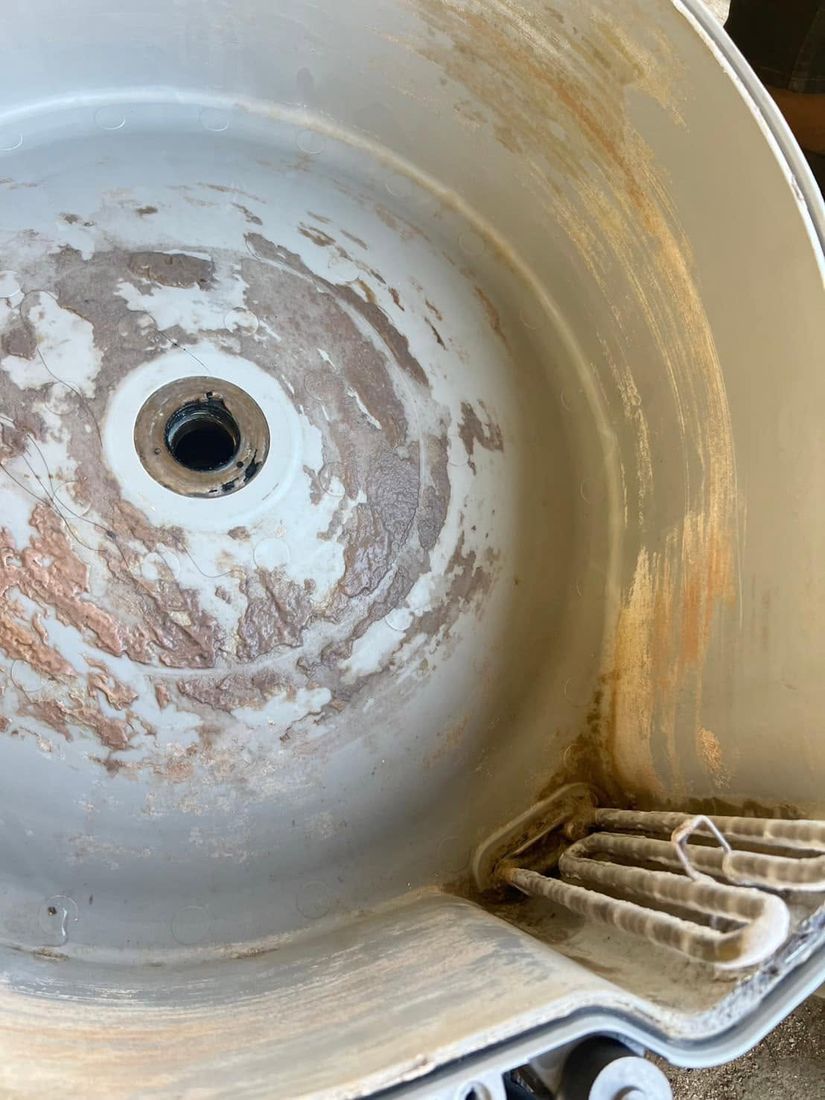
The most common answer online is once a year. That is not wrong, but it is not enough to judge any particular home's machine, because a household that does laundry every day, including baby clothes, and a person living alone who washes twice a week cannot possibly build up residue at the same rate.
A more useful way to judge is to look at what makes residue build up faster, then compare that with your own home.
Where the residue comes from, and what speeds it up
Every time the machine runs, water mixed with detergent flows through the holes in the inner drum into the gap between the two drums. Undissolved detergent, fabric softener and lint are left clinging to the outside of the inner drum and the wall of the outer drum. Add the moisture that stays behind after each wash, and that spot becomes a place where mould and bacteria grow well.
Once you understand this, you can see there are only a few things that speed it up, and you control almost all of them.
- Number of washes per week: the more often you wash, the faster residue builds up. This is the clearest factor of all.
- Amount of detergent: using more than the label says leaves more undissolved detergent behind; it does not get clothes any cleaner.
- Regular use of fabric softener: softener coats the drum and binds with lint more easily than detergent does.
- Washing only in cold water: some detergents do not dissolve well in cold water, so more sediment is left behind.
- Closing the lid or door straight after a wash: this keeps moisture trapped in the drum, which is exactly what mould needs.
- Leaving wet laundry in the machine overnight: of everything on this list, this brings on smells the fastest.
The intervals I use as a starting point
This table is a starting point for judging, not a fixed rule. If your home matches several of the factors above, move towards the more frequent end.
- Type of useWashing every day, with baby clothes or heavily soiled laundry
- Starting strip-down clean interval
- Once a year
- Type of useWashing almost every day, medium-sized family
- Starting strip-down clean interval
- Every 12 to 18 months
- Type of useWashing 2–3 times a week
- Starting strip-down clean interval
- Every 1–2 years
- Type of useWashing once a week, living alone
- Starting strip-down clean interval
- Every 2 years, or based on symptoms
- Type of useMachines in dormitories or coin-operated machines
- Starting strip-down clean interval
- More often than any of the above; assessed on site
| Type of use | Starting strip-down clean interval |
|---|---|
| Washing every day, with baby clothes or heavily soiled laundry | Once a year |
| Washing almost every day, medium-sized family | Every 12 to 18 months |
| Washing 2–3 times a week | Every 1–2 years |
| Washing once a week, living alone | Every 2 years, or based on symptoms |
| Machines in dormitories or coin-operated machines | More often than any of the above; assessed on site |
I should stress that this interval refers to strip-down cleaning only. The parts you can look after yourself, such as the lint filter, the detergent drawer and the door seal, should be cleaned regularly every week to every month anyway, however far apart your strip-down cleans are.
Checks that are more reliable than counting months
- 1
Smell the drum when the machine is completely dry
Open a machine that has not been used for at least a day and smell inside the drum. If you notice a musty or sour smell even with no laundry inside, the residue has built up to the point where it is having an effect. This is more reliable than smelling it straight after a wash, when the scent of detergent masks it.
- 2
Look for black spots on the door seal and under the lid rim
On a front loader, pull back the folds of the rubber seal around the door and look inside. On a top loader, look under the rim of the lid and around the mouth of the drum. The small black spots you see are the part that has already surfaced, and they usually mean there is many times more inside than you can see.
- 3
Run one load of white laundry without detergent
If brown or black flakes come off and stick to the laundry, the residue inside has started to peel away. This is the clearest sign that the machine needs a strip-down clean, because whatever comes loose will cling to the clothes in later loads.
- 4
Notice whether clothes dry more slowly or smell after drying
If clothes that have dried on the line still have a musty smell when you wear them, even though they dried somewhere with good airflow, the smell came from the machine, not from the drying.
How to stretch the time between cleans
- Leave the lid or door open after a wash until the drum is dry, rather than closing it straight away.
- Take laundry out as soon as the wash finishes, and never leave it overnight.
- Use the amount of detergent stated on the label, and do not add extra to be safe.
- Clean the lint filter every 1–2 weeks and the detergent drawer once a month.
- Wipe the folds of the door seal on a front loader once a week.
- If you use fabric softener regularly, run the drum-clean cycle as described in your machine's manual about once a month (some brands, such as Samsung, remind you every 40 washes).
Doing all six of these helps a lot, but only in the areas that water and hands can reach. Residue on the outside of the inner drum keeps building up with every wash, just more slowly.
Prices and scope of work
- Machine typeTop loader, up to 15 kg
- Price
- 999 THB
- Machine typeTop loader, 15.1–19 kg
- Price
- 1,200 THB
- Machine typeTop loader, over 19 kg
- Price
- 1,500 THB
- Machine typeFront loader
- Price
- From 1,299 THB
- Machine typeIf the machine has to be taken away to be cleaned off site
- Price
- Add 500 THB
| Machine type | Price |
|---|---|
| Top loader, up to 15 kg | 999 THB |
| Top loader, 15.1–19 kg | 1,200 THB |
| Top loader, over 19 kg | 1,500 THB |
| Front loader | From 1,299 THB |
| If the machine has to be taken away to be cleaned off site | Add 500 THB |
My scope of work is stripping down and cleaning the drum. If I find during the check that the machine already has a fault, I tell you exactly what I see and recommend contacting that brand's service centre. Cleaning one machine takes about 3 hours, and the work I do carries a 30-day warranty.
Not sure whether your machine is due yet? Send me photos of the inside of the drum and the door seal on LINE. I will take a look first and tell you honestly if it is not time yet. Call +66 65 365 7673 or add LINE @794xvrnm.