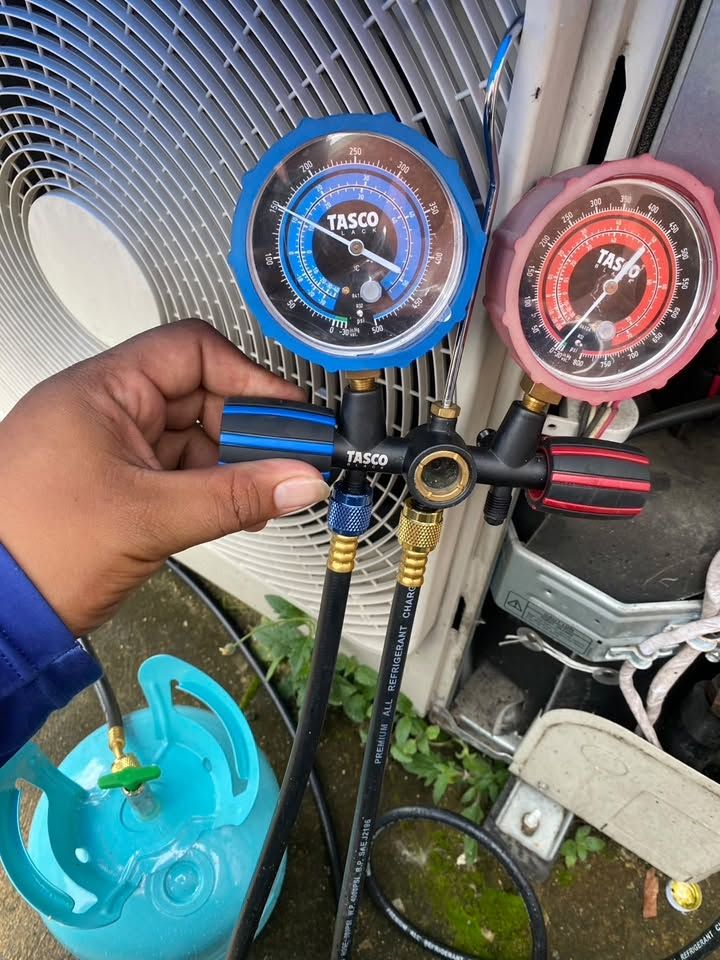
Moving an aircon looks simple from the outside: take the unit off the old wall and fit it on the new one. But technically, the job has several steps that are invisible and cannot be checked from the outside, and they are hard for a customer to check by eye on the day.
The problem is that the damage does not show straight away. The unit cools normally for the first week, then starts cooling less a few months later, or at worst the compressor fails, which in jobs I have come across can happen within a year. So I want to explain which steps cannot be skipped, and why.
The first step that must be done properly: pumping the refrigerant back into the unit
Before disconnecting the pipes from the outdoor unit, the unit has to be run and the valves closed in sequence, so that all the refrigerant in the system is drawn back and stored in the outdoor unit first. This step takes only a few minutes, but if it is skipped and the pipes are simply disconnected, all the refrigerant in the system is released into the air.
In my jobs, pumping the refrigerant back into the unit is included in the moving price.
Vacuuming at the new location: a step you cannot check by eye
Once the pipes are connected at the new location, there is air and moisture left inside them. A vacuum pump has to draw it all out before the valves are opened to let the refrigerant into the system. If this step is skipped, the leftover moisture combines with the lubricating oil in the compressor and corrodes the system from the inside.
The effect of skipping the vacuum does not show on the day; the unit cools perfectly normally. But the damage builds up quietly until the compressor starts working abnormally hard. That is why I stress this step in both new installations and moves.
Other points to check when moving an aircon
- 1
Check the condition of the old refrigerant pipes before reusing them
Pipes that have been bent several times or have kinks should not be reused, because the kinked spot restricts the refrigerant flow and becomes a leak point in future. I will tell you first if I find that new pipes are needed.
- 2
Check the pipe length against the new location
If the new spot is further away than before, the pipes have to be extended, which costs extra. I measure the distance and tell you the extra cost before work starts.
- 3
Choose a new location where the water can drain
The drain pipe of a home aircon flows by gravity, so the new location must let the pipe slope downwards all the way. If the unit is forced into a spot where the pipe has to climb, dripping problems will certainly follow.
- 4
Fix the bracket to a structure that can really take the weight
With lightweight or gypsum walls, you need to find the steel frame inside to fix to, not just drive anchors into bare gypsum board, because vibration will work them loose later.
- 5
Seal the old wall hole properly
The pipe hole at the old location has to be sealed, otherwise it becomes a way in for rainwater and insects. This step is already included in my removal work.
What moving an aircon costs in Chiang Mai
- ItemAircon relocation: removal from the old spot and installation at the new one
- Charge
- 3,500 THB
- Notes
- Includes pumping the refrigerant back into the unit and vacuuming at the new location
- ItemAircon removal only, no reinstallation
- Charge
- 700 THB
- Notes
- Includes sealing the old wall hole
- ItemExtra pipework beyond the standard length
- Charge
- Quoted before work starts
- Notes
- Always measured on site first
- ItemR32 / R410A refrigerant top-up
- Charge
- 25 THB per pound
- Notes
- Only when the system is actually low
| Item | Charge | Notes |
|---|---|---|
| Aircon relocation: removal from the old spot and installation at the new one | 3,500 THB | Includes pumping the refrigerant back into the unit and vacuuming at the new location |
| Aircon removal only, no reinstallation | 700 THB | Includes sealing the old wall hole |
| Extra pipework beyond the standard length | Quoted before work starts | Always measured on site first |
| R32 / R410A refrigerant top-up | 25 THB per pound | Only when the system is actually low |
If the move is done with all the steps, there is normally no need for a refrigerant top-up, because the original refrigerant has been stored back in the unit. A top-up is only needed if the system already had a leak, which I will check and tell you about first.
What to prepare before moving day
- Decide clearly on the new location, and clear the space both inside and outside the building.
- Check whether there is a power point or breaker to supply the new spot. If not, extra wiring will be needed.
- For condos or housing estates, check with the building or estate management whether you need permission to install the outdoor unit.
- Let me know the BTU size and the age of the unit in advance, so I can assess whether it is worth moving.
If you are about to move house or change where your aircon goes, send the BTU size, the number of units, and photos of the old and new locations to our aircon LINE account @iu3333, so the pipe length and materials can be assessed before booking.